Building stronger muscles and reversing weakness starts with giving your body a clear signal to adapt. When you challenge muscles consistently and fuel them properly, they respond by rebuilding stronger than before. Weak muscles do not improve by chance. They improve when you train with intention, move with control, and support recovery with smart nutrition. Most people begin seeing strength changes within weeks when they stay consistent. The key is not random workouts, but a structured approach that supports both muscle activation and long term performance improvement.
What Is Muscle Weakness?
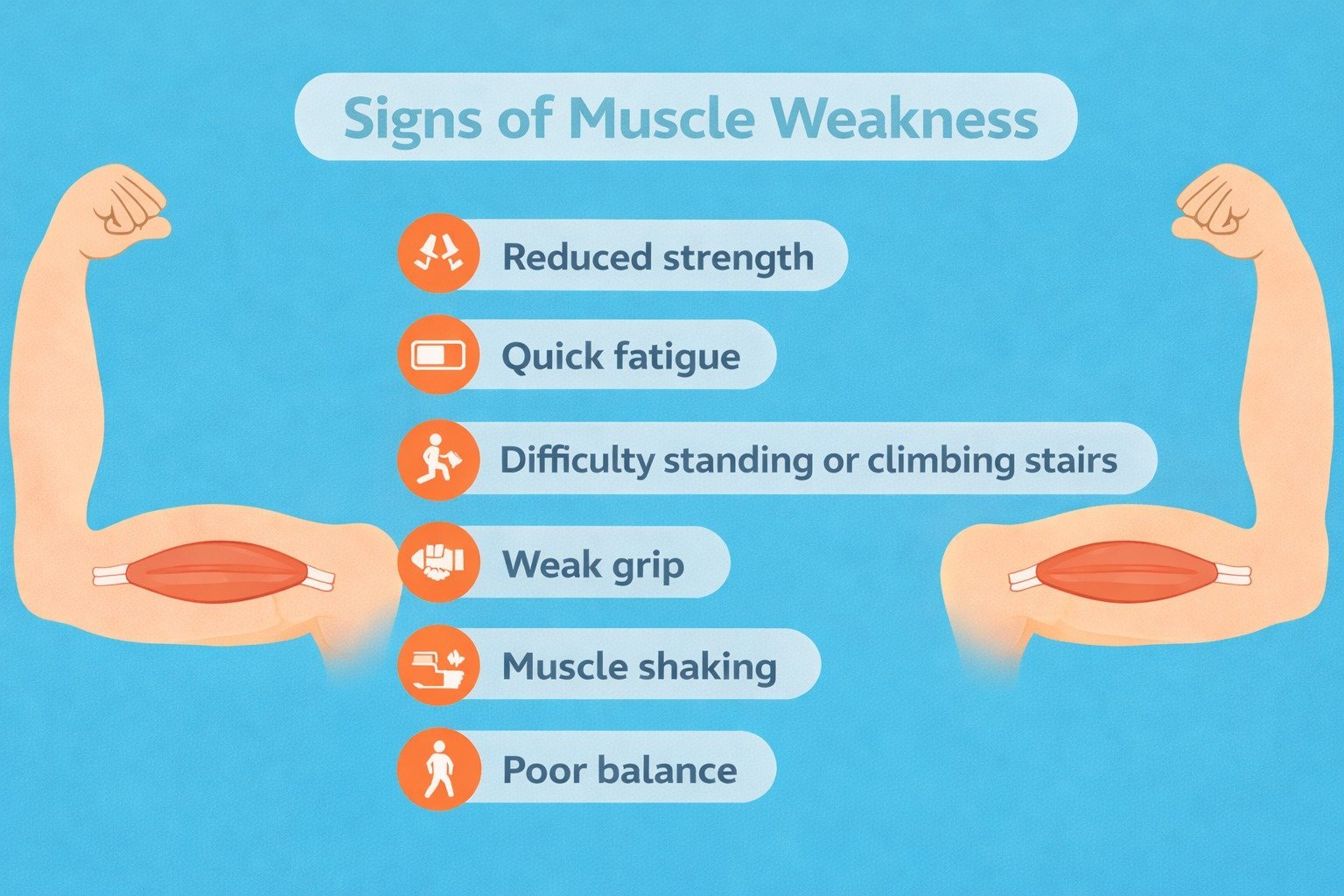
Muscle weakness is a decrease in a muscle’s ability to produce normal strength during movement, meaning the muscle cannot generate the force expected for a specific task. It can be temporary, such as after intense exercise, dehydration, or illness, or persistent due to muscle atrophy, nerve damage, electrolyte imbalance, chronic inflammation, or underlying neurological conditions. People with muscle weakness may experience early fatigue, trembling during effort, reduced grip strength, difficulty rising from a seated position, slowed walking speed, or instability while standing. In medical evaluation, clinicians distinguish between true muscle weakness (an objective loss of strength) and perceived weakness (a feeling of fatigue without measurable loss), using strength testing and functional assessments to determine whether the cause is muscular, neurological, metabolic, or systemic in origin.
Why Muscles Become Weak in the First Place
Muscles weaken when they are not exposed to consistent mechanical demand. Without regular resistance or functional loading, muscle fibers shrink and lose force capacity. This is known as atrophy.
Weakness also occurs when nerve signaling becomes inefficient. Injury, joint restriction, or chronic pain can disrupt normal muscle activation. Even if muscle size appears unchanged, force production may decline.
Hormonal shifts, prolonged sitting, chronic inflammation, and nutrient deficiencies further accelerate strength loss. Over time, inhibited muscles cause compensatory movement patterns, reducing joint stability and endurance.
Identifying the root cause is essential before applying strategies for how to build muscle effectively. Correcting dysfunction produces stronger and more sustainable outcomes than simply increasing exercise volume.
The Science Behind How to Build Muscle
Muscle development occurs when the body adapts to controlled physical stress. During strength training, muscle fibers experience strain that signals the body to rebuild them stronger than before. This rebuilding process depends on muscle protein synthesis, adequate amino acids from food, sufficient energy intake, and proper recovery. As resistance gradually increases, the nervous system improves motor unit recruitment, allowing greater force production. Over time, consistent training combined with adequate rest leads to increased lean tissue, improved strength output, and enhanced functional performance.
Nutrition and Key Supplements for Muscle Growth
Nutrition determines whether muscle rebuilding succeeds or stalls. Resistance training provides stimulus, but nutrients provide the raw materials.
Key nutritional principles include:
Daily protein intake of 1.2 to 1.6 grams per kilogram of body weight
Balanced carbohydrate intake to replenish glycogen stores
Healthy fats to support hormonal function
Sufficient caloric intake to sustain anabolic processes
Evidence supported supplements include:
Creatine monohydrate to enhance strength output
Essential amino acids to support muscle protein synthesis
Vitamin D to improve muscle function
Magnesium to assist contraction and recovery
Nutritional consistency ensures that mechanical loading results in structural adaptation.
You Need A Muscle Specialist
How to Improve Weak Muscles
Improving weak muscles requires more than simply adding weight to your workouts. First, identify the root cause of weakness. Some muscles weaken due to disuse, while others shut down because of poor movement patterns or nerve inefficiency. Start with controlled activation drills to restore proper firing patterns. Then introduce structured strength training that challenges the muscle without causing overload. Focus on quality of movement, controlled tempo, and balanced muscle recruitment. Support this process with adequate nutrition, hydration, and recovery cycles. When activation, resistance, and recovery work together, muscle strength improves steadily and sustainably.
How to Improve Muscle Weakness Based on the Underlying Cause
Muscle weakness improves only when the root cause is identified. Weakness may originate from local muscle deconditioning, nerve signaling disruption, circulatory inefficiency, postural imbalance, or systemic medical conditions. Treatment depends on which system is affected.
Localized Skeletal Muscle Weakness (Legs, Back, Pelvic Floor)
When weakness affects skeletal muscles such as the legs, lower back, or pelvic floor, the solution focuses on targeted activation, endurance retraining, and structural stabilization. Controlled strengthening drills, balance retraining, posture correction, and coordinated breathing techniques restore support and movement efficiency.
Neurological or Coordination-Based Weakness (Eye Muscles)
Eye muscle weakness often relates to impaired visual tracking or coordination rather than loss of strength. Guided ocular exercises and convergence training improve control and reduce strain.
Systemic or Cardiac Muscle Weakness (Heart Muscle)
Heart muscle weakness is a medical condition requiring physician-supervised care. Structured cardiac rehabilitation and monitored aerobic conditioning improve cardiovascular performance safely.
Improving muscle weakness requires matching the intervention to the biological source of dysfunction. General exercise alone is not sufficient. Precision in diagnosis determines effectiveness of treatment.
You Need A Muscle Specialist
Muscle Strength and Recovery for Athletes and Sports Performance
Athletes build stronger muscles through sport-specific resistance training, progressive overload, and structured recovery. Training two to three times per week with adequate protein intake improves power, speed, and muscular endurance. Effective athletic recovery includes mobility work, sports massage therapy, and neuromuscular activation to enhance motor unit efficiency and prevent injury. Strong athletic muscles depend on coordinated force production, joint stability, and proper recovery between high-intensity sessions.
Best Muscle Recovery and Muscle Pain Relief Therapies for Stronger Muscles
To improve muscle recovery, relieve pain, and build stronger muscles, Synergy Release Sports offers advanced performance therapies:
- Recover Pumps (Normatec Compression): Improve circulation and reduce post-workout muscle soreness.
- Red Light Therapy: Support cellular repair and reduce inflammation.
- PEMF Therapy: Enhance tissue healing and recovery speed.
- Active Release Technique (ART): Break down scar tissue and reduce chronic muscle pain.
- Myofascial Release : Release tight muscle fibers and restore mobility.
- AMIT (Advanced Muscle Integration Technique): Reactivate inhibited muscles and improve strength output.
- Synergy Release Technique: Improve neuromuscular coordination and functional strength.
These therapies work together to accelerate muscle recovery, reduce pain, and support long-term muscle growth safely.
Top 10 Best Ways to Build Muscle
Building muscle mass safely requires a strategic approach rather than random effort. The following methods create consistent progress while minimizing injury risk:
- Train with Progressive Overload – Gradually increase resistance, repetitions, or time under tension to continuously challenge muscle fibers and stimulate adaptation.
- Focus on Compound Exercises – Multi joint movements such as squats, deadlifts, lunges, and presses recruit larger muscle groups and improve overall strength efficiency.
- Train Two to Three Times Per Week – Structured frequency allows adequate stimulus while preserving recovery capacity.
- Eat Enough Protein Daily – Approximately 1.2 grams per kilogram of body weight supports muscle repair and lean tissue development.
- Consume Protein After Workouts – Providing amino acids within one hour post training enhances muscle rebuilding.
- Prioritize Sleep – Seven to nine hours of quality sleep supports hormonal balance and tissue recovery.
- Correct Joint Restrictions – Proper alignment and mobility ensure force is distributed evenly, preventing compensatory weakness.
- Activate Weak Muscles First – Use targeted activation techniques before training to improve contraction quality and motor control.
- Allow Forty Eight Hours Recovery – Rest between sessions enables structural repair and strength adaptation.
- Stay Consistent for Months – Sustainable muscle growth requires repeated stimulus over time rather than short bursts of effort.
When applied together, these principles create measurable improvements in strength, endurance, and lean muscle mass.
You Need A Muscle Specialist
Common Mistakes That Slow Muscle Growth
Muscle growth does not stop because the body is incapable. It usually slows because the strategy is flawed. Many people train hard but overlook key factors such as recovery, nutrition, movement quality, and training structure. Small mistakes repeated over time prevent progress. Identifying and correcting these errors allows muscle protein synthesis, nervous system efficiency, and mechanical loading to work together properly.
Common mistakes that slow muscle growth include:
- Training Without Progressive Load
Repeating the same weight and repetitions for months prevents adaptation. Muscles require increasing challenges to grow.
- Overtraining Without Recovery
Training daily without rest elevates cortisol levels and limits tissue repair, reducing strength gains.
- Insufficient Protein Intake
Without adequate amino acids, muscle rebuilding cannot occur efficiently.
- Ignoring Total Caloric Intake
Trying to gain muscle while eating too few calories limits energy available for growth.
- Poor Exercise Technique
Incorrect form shifts stress away from target muscles and increases injury risk.
- Skipping Activation Work
Weak or inhibited muscles cannot produce full force even under load.
- Neglecting Sleep Quality
Inadequate sleep disrupts growth hormone release and slows recovery.
- Relying Only on Supplements
No supplement replaces structured resistance training and proper nutrition.
- Lack of Training Structure
Random workouts without periodization reduce measurable progress.
- Inconsistent Training Schedule
Sporadic sessions prevent the repeated stimulus required for long term muscle development.
Correcting these mistakes restores the proper environment for muscle growth and improves overall strength progression.
Building Muscle at Any Age
Muscle growth is possible at every stage of adulthood, but the approach must adjust to changing recovery capacity, hormone levels, and training tolerance. In your twenties and thirties, muscle gains often occur faster because anabolic hormone levels and neuromuscular efficiency are higher. Progressive resistance training combined with sufficient calorie intake and structured programming can produce noticeable strength improvements within weeks. However, inactivity during these years can still lead to early muscle loss, especially with prolonged sitting or inconsistent training habits.
After forty, muscle protein synthesis slows and recovery demands increase, which means training must be more intentional. Greater emphasis on mobility, joint stability, and adequate protein intake becomes essential. Research consistently shows that resistance training at least twice per week produces measurable improvements in muscle strength and lean mass even in older adults. Muscle loss is not permanent. Age alone does not prevent muscle growth. Inactivity and lack of stimulus are the primary drivers of decline. With consistent mechanical loading, proper recovery, and balanced nutrition, muscle strength can improve across decades.
You Need A Muscle Specialist
Long-Term Muscle Mass Building Strategy
Long-term muscle development depends on structured programming. Effective strategies include phased progression, volume adjustments, deload cycles, mobility maintenance, and consistent performance tracking. Muscle mass increases gradually through repeated stimulus applied over months and years. Sustainable growth requires discipline, not intensity spikes.
Improve Weak Muscles with Synergy Release Sports Atlanta
Synergy Release Sports Atlanta combines chiropractic alignment, neuromuscular activation, corrective exercise, and soft tissue therapy to restore efficient muscle function. By addressing movement dysfunction, joint restriction, and muscle inhibition, patients experience measurable improvements in strength, stability, and performance. Clinical guidance ensures muscle rebuilding occurs safely and progressively.